
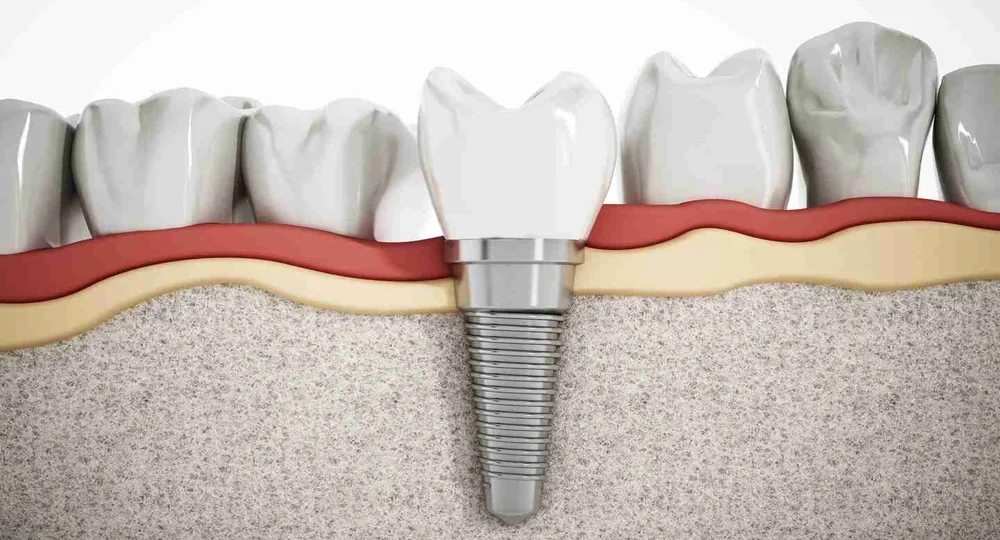

“Screwless” is a marketing term rather than a clinical category, and it usually refers to one of two different things: an implant system whose abutment locks in by friction instead of a screw, or a crown cemented onto an abutment so no screw access hole shows on the chewing surface. Neither one eliminates surgery, which is the misconception worth clearing up first. Patients asking an implant practice such as Stubbs Dental for a screwless option are often surprised to learn the post still goes into the jawbone the same way, and that the difference sits entirely in how the parts above the bone connect.
Are there implants with no screw at all?
Yes, in systems built around a locking taper connection. A locking taper, sometimes called a friction-fit or cold-weld connection, joins the abutment to the implant by tapping a slightly tapered post into a matching socket, where mechanical friction holds it without threads.
Bicon is the best-known example, having used a plateau root form design with a 1.5-degree locking taper since the 1980s. Its implants are finned rather than threaded, so the fixture itself is not screw-shaped either, and the abutment can be seated at any rotational position rather than at fixed indexed points. The company also markets notably short implants, down to around 5 to 6 millimeters, which the design is intended to support in cases where bone height is limited.
Plenty of other systems use conical or Morse taper connections that look similar and still use a retaining screw. The conical shape improves the seal and load distribution; the screw remains.
What is a screw-retained crown, and how is a cemented one different?
A screw-retained crown attaches directly to the implant through a channel in the tooth’s biting surface, which gets filled with composite afterward. A cement-retained crown is glued onto an abutment, the way a conventional crown fits over a prepared tooth, leaving no visible access hole.
The trade-off is retrievability against appearance. A screw-retained crown can be unthreaded in minutes for repair, hygiene access, or replacement, and that matters most on full-arch prosthetics that need periodic servicing. Cemented crowns look seamless and work better when the implant sits at an awkward angle, but removing one often means cutting it off and paying for a new crown. Excess cement pushed below the gum line during seating is also a documented risk factor for peri-implantitis, the inflammatory bone loss that threatens implants years after placement.
Does going screwless actually avoid screw problems?
It removes one failure mode and introduces different ones. Abutment screw loosening is among the technical complications most often reported in reviews of implant restorations, though it is a nuisance repair rather than a threat to the implant, and it has become less frequent as manufacturers refined connection geometry and torque specifications. Most abutment screws are tightened to a manufacturer-specified value in the range of 15 to 35 newton centimeters, and using a calibrated torque wrench rather than hand pressure is what prevents most loosening.
Friction-fit connections cannot loosen in the same way. Separating one when service is needed requires system-specific instruments, which is manageable at the placing office and considerably harder if you move away or that office closes. Component availability is the practical consideration with any less common system, since a crown needing repair in fifteen years depends on parts still being manufactured.
Does the connection type change how long an implant lasts?
Not in a way the evidence clearly supports. Systematic reviews comparing screw-retained and cement-retained restorations have generally found similar survival rates, with different complication profiles rather than a winner. Screw-retained work sees more screw loosening and occasional composite chipping at the access hole; cemented work sees more cement-related inflammation and lost crowns.
What drives longevity is the same list regardless of hardware: plaque control at the gum line, professional maintenance every three to six months, no smoking, and a night guard for anyone who grinds. A connection choice is a clinical detail, not a survival strategy.
What should you ask a practice like Stubbs Dental about the connection they use?
Ask which implant system they place and why, then ask how a repair works in ten years. That second question separates thoughtful answers from sales pitches.
Worth raising specifically: is the crown screw-retained or cemented and why for your case, will the access hole be visible, how is the crown removed if it needs servicing, and are replacement components readily available for the system. Stubbs Dental is one practice worth reviewing on these questions when comparing providers, since offices that both place and restore implants choose the connection with the eventual repair in mind rather than leaving it to whoever handles the restoration later.
Screwless designs are legitimate engineering, not a gimmick, and they are also not the breakthrough some websites suggest. The choice between friction-fit and threaded, cemented and screw-retained, should follow the position of the tooth, the angle of the implant, and how easily the restoration can be serviced years from now. Bring those questions to a consultation, at Stubbs Dental or wherever you are considering treatment, and ask which system will still have parts available when your crown needs attention.